Hosting cost
-¥10K+/yr-¥10K+/yr
No-code subscription eliminated
Loading project...
Owner, Designer & Developer
Solo, with an AI-native development workflow
Migration project, then continuous evolution
The site you are reading is itself a production system: migrated from a no-code builder to Next.js on Vercel, cutting hosting costs while gaining full control — then hardened with 6 automated test suites, visual regression, and CI. Maintained through the same AI-native workflow I use at work.
The original site was built on a no-code platform during my UX training — great for shipping fast then, but it locked content behind a subscription, capped performance, and made every structural change a manual chore. As my work shifted toward engineering, the site also became a credibility question: can someone claiming 'strategy to code' really not own their own stack?
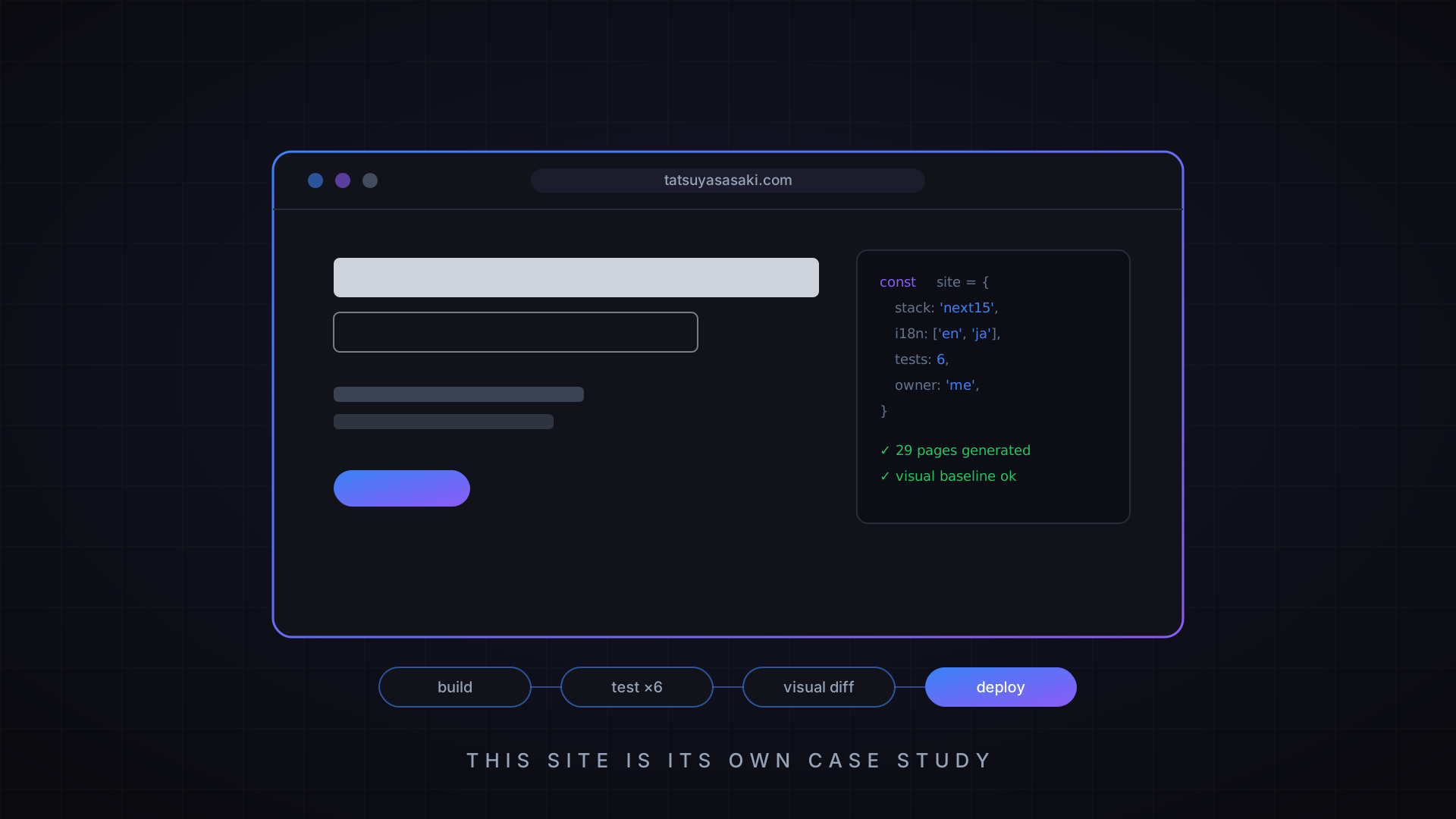
A full rebuild on Next.js 15 (App Router) + TypeScript + Tailwind, deployed on Vercel: hosting costs dropped by over ¥10,000/year while gaining i18n (en/ja), dark editorial design with motion, and content as version-controlled Markdown. Quality is enforced by machines: Playwright suites for smoke, accessibility (axe), SEO, performance, and cross-browser testing, plus visual regression baselines — the same engineering discipline I apply to enterprise systems, at personal-site scale.
The original site was built on a no-code platform during my UX training — great for shipping fast then, but it locked content behind a subscription, capped performance, and made every structural change a manual chore. As my work shifted toward engineering, the site also became a credibility question: can someone claiming 'strategy to code' really not own their own stack?
A full rebuild on Next.js 15 (App Router) + TypeScript + Tailwind, deployed on Vercel: hosting costs dropped by over ¥10,000/year while gaining i18n (en/ja), dark editorial design with motion, and content as version-controlled Markdown. Quality is enforced by machines: Playwright suites for smoke, accessibility (axe), SEO, performance, and cross-browser testing, plus visual regression baselines — the same engineering discipline I apply to enterprise systems, at personal-site scale.
Eat your own cooking: if I advocate AI-native, test-first, evidence-driven development at work, my own site should be built the same way — and be inspectable proof of it. Dark, editorial, motion-driven design signals the shift from 'designer with a portfolio' to 'builder whose portfolio is itself a build'.
Smoke, accessibility (axe), SEO, performance (Lighthouse), cross-browser, and visual regression — on a personal site.
next-intl with locale routing; every string, project, and metadata exists in English and Japanese.
Projects and profile live in version-controlled Markdown — every wording change is a reviewable diff.
Built and evolved with the same AI-assisted, guardrailed workflow used for enterprise work — this content overhaul included.
Rebuilt route by route with tests as the safety net: each page shipped with its Playwright coverage, and visual baselines catch unintended changes on every run. The dark editorial redesign and this Strategy-to-Code content overhaul were both executed as reviewable, test-verified changes — the site's git history is the case study.
No-code subscription eliminated
Smoke / a11y / SEO / perf / cross-browser / visual
Full English / Japanese parity
Code, content, and pipeline — all version-controlled